Shingal Stands With the SDF — Honouring Their Role Saving Yazidis and Defending Kurdish Homeland
- The Yazidi house in Australia Inc

- Jan 20
- 2 min read
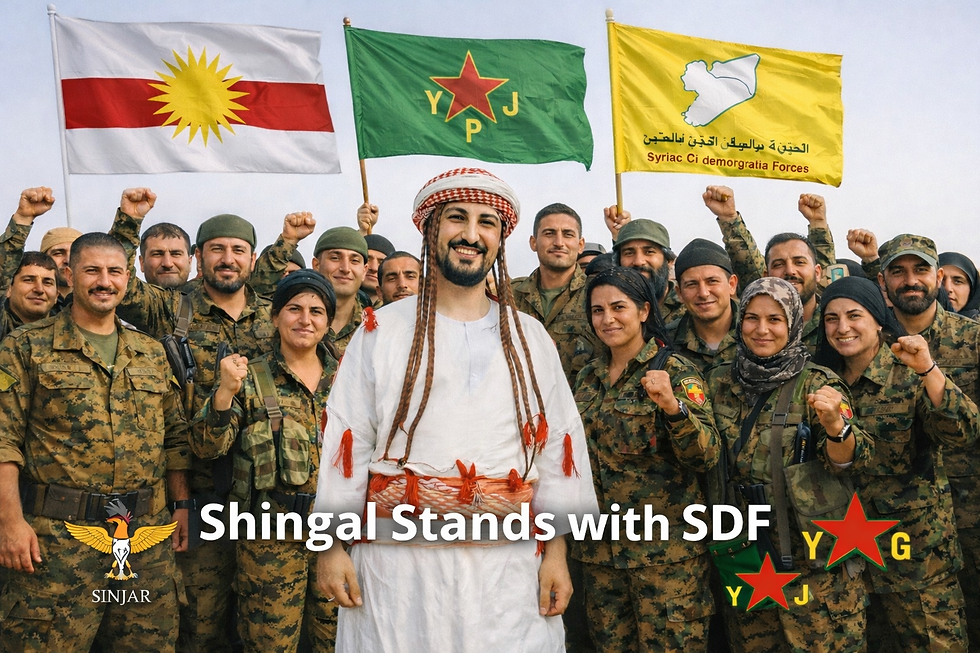
When ISIS launched its genocidal campaign against the Yazidis in August 2014, thousands were killed, up to 7,000 women and children were abducted, and many were left stranded without food or water on Mount Sinjar. The United Nations and human rights organisations have classified these events as genocide.
In that crisis, the Syrian Democratic Forces (SDF) — a multi-ethnic, Kurdish-led alliance including the YPG — were among the ground forces that fought ISIS and opened escape routes for trapped Yazidis, enabling thousands to flee to safety.
More than a decade later, the SDF continues to rescue Yazidi captives still held by ISIS sleeper cells and disrupt extremist networks, even as the broader conflict in Syria evolves.
New Power Struggles: SDF vs Ahmed al-Sharaa (Jolani) Over Hasakah, Qamishli and Rojava
In late 2024 and into 2026, Syria’s political landscape shifted dramatically after Ahmed al-Sharaa — also known as Abu Mohammed al-Jolani, leader of Hay’at Tahrir al-Sham (HTS) and head of the new Syrian administration — extended his authority across formerly autonomous regions.
Under a ceasefire and integration deal, the SDF agreed to withdraw from several contested areas to avoid further bloodshed, while Damascus under Sharaa moved to consolidate control over strategic provinces such as Raqqa and Deir el-Zour.
However, Hasakah and Qamishli — core cities of the Kurdish-led Rojava homeland — remain contested. Negotiations between the SDF and Sharaa’s government have stalled, with divergent positions over administrative control and the future of Kurdish forces within a unified Syrian army.
Sharaa has publicly stated his intention to bring all armed groups, including Kurdish forces, under state control and integrate them into the national defence structures, while acknowledging Kurds as part of the Syrian nation.
The SDF, for its part, has insisted on maintaining local governance authority in Hasakah and the northeast, reflecting a broader determination to protect gains made in Rojava since the fight against ISIS.


Comments